 Current
location:
Current
location: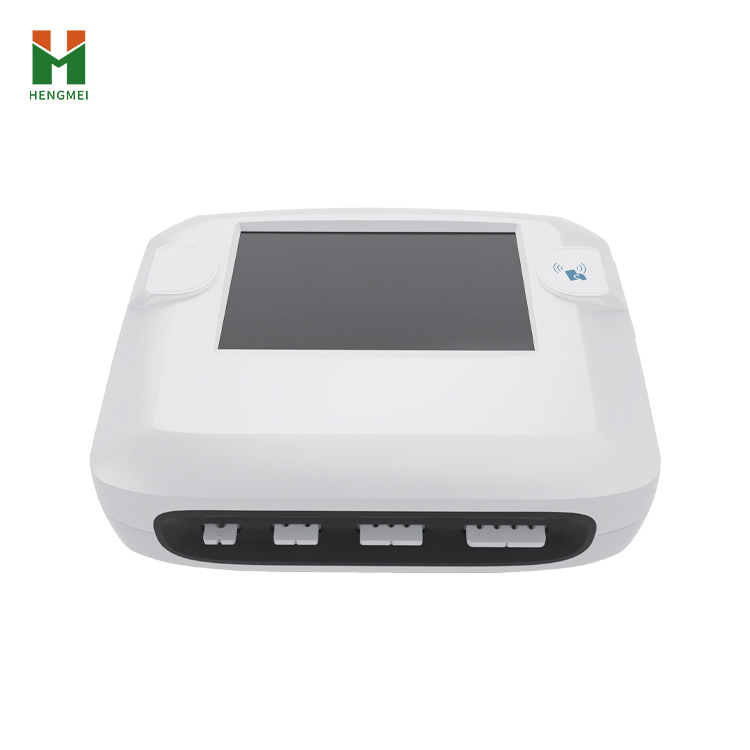
 +86
17853698681
+86
17853698681



Product Introduction
Research laboratories and biosafety facilities face a distinct set of challenges when working with colloidal gold immunochromatographic assay (GICA) test strips. Unlike routine quality control environments that standardize on one or two strip formats, research settings frequently transition between single-analyte validation studies, dual-parameter screening assays, and comprehensive multi-analyte combination panels — each requiring different card configurations. This diversity often forces laboratories to maintain multiple readers or accept the compromise of using suboptimal card formats for certain assays.
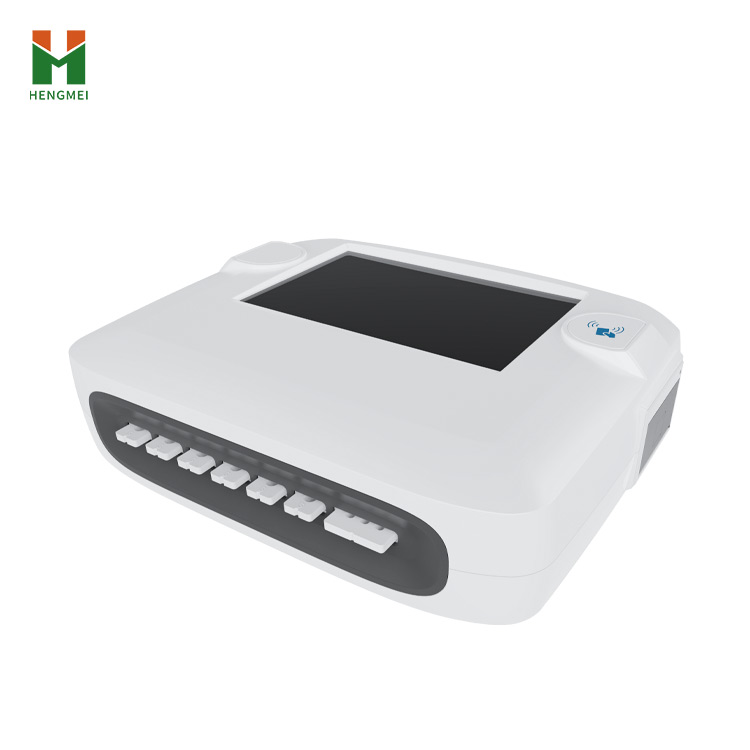
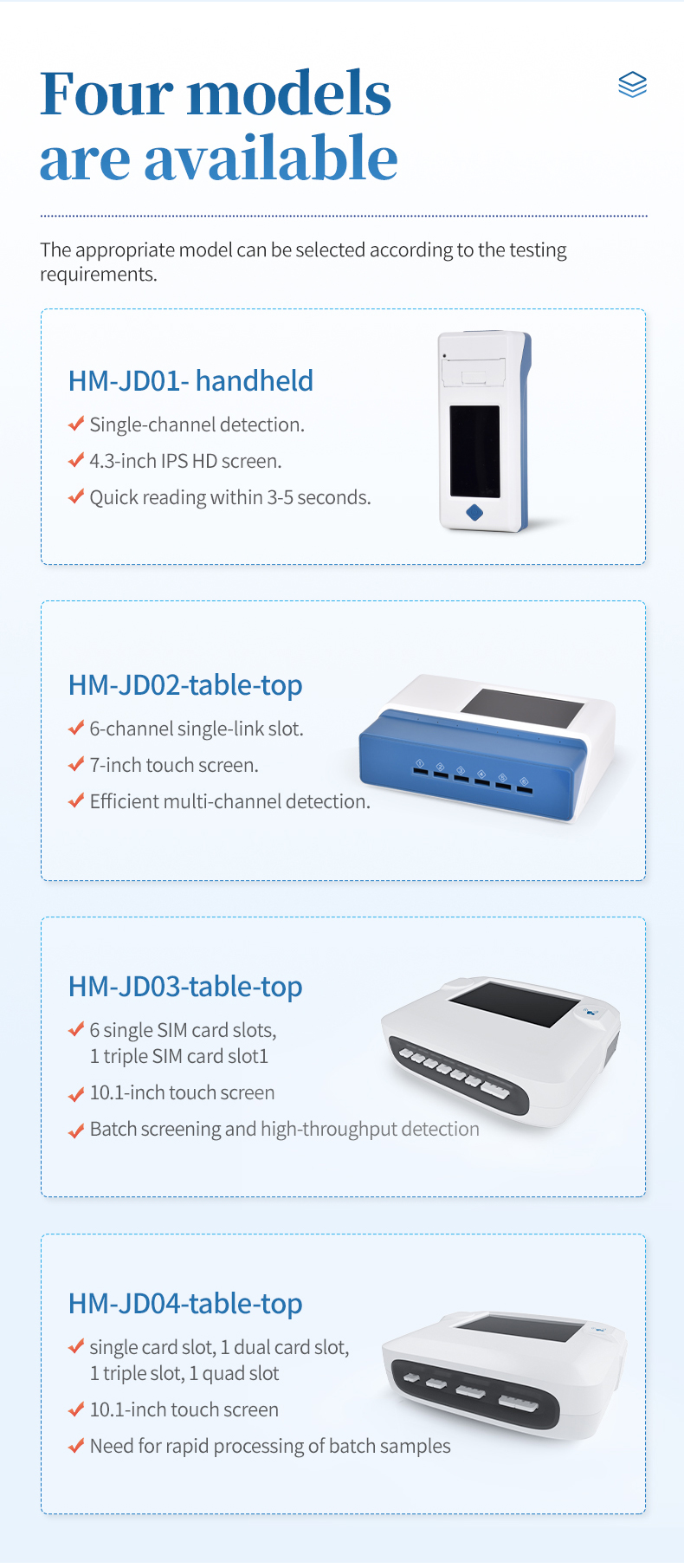
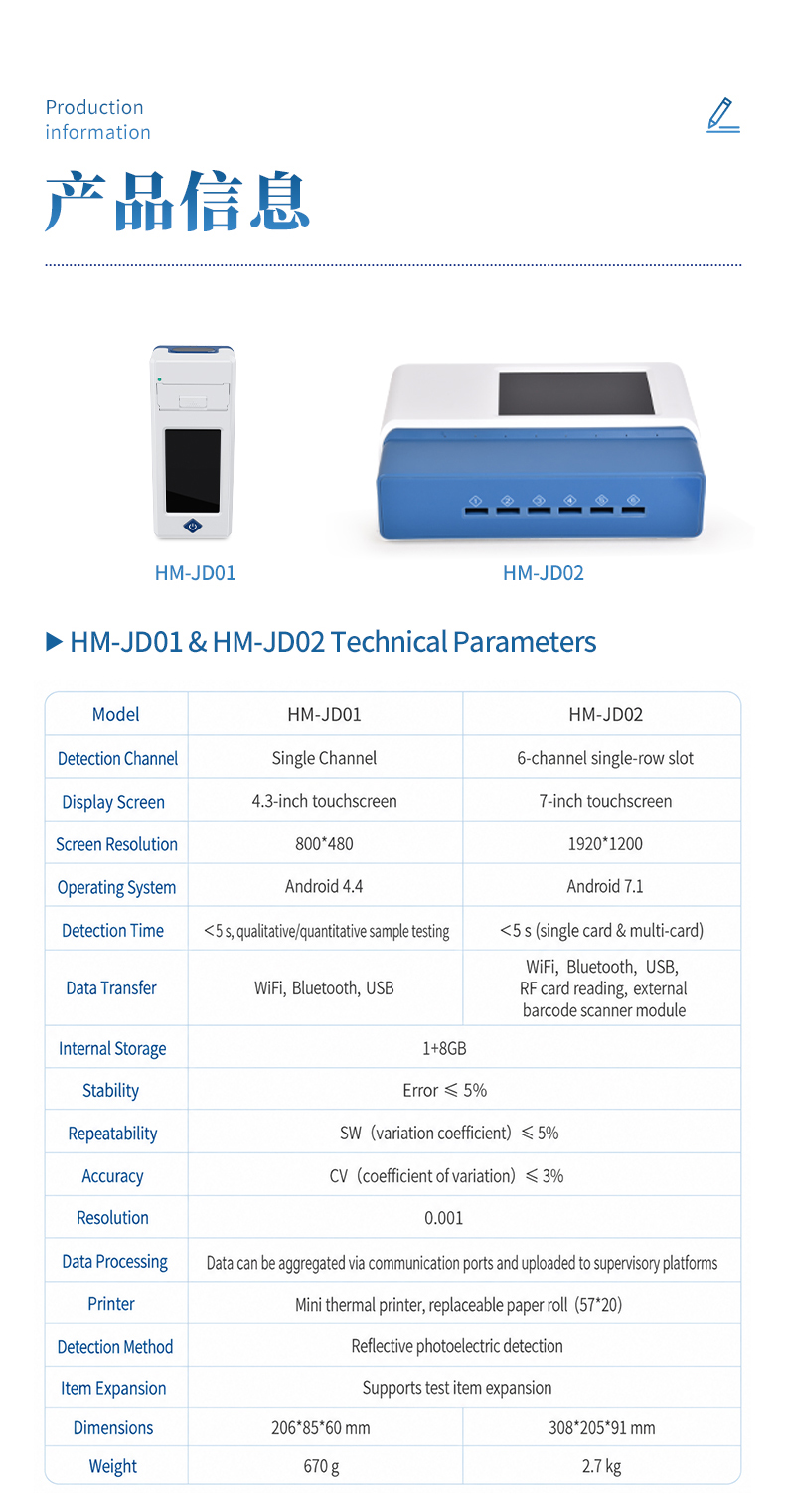
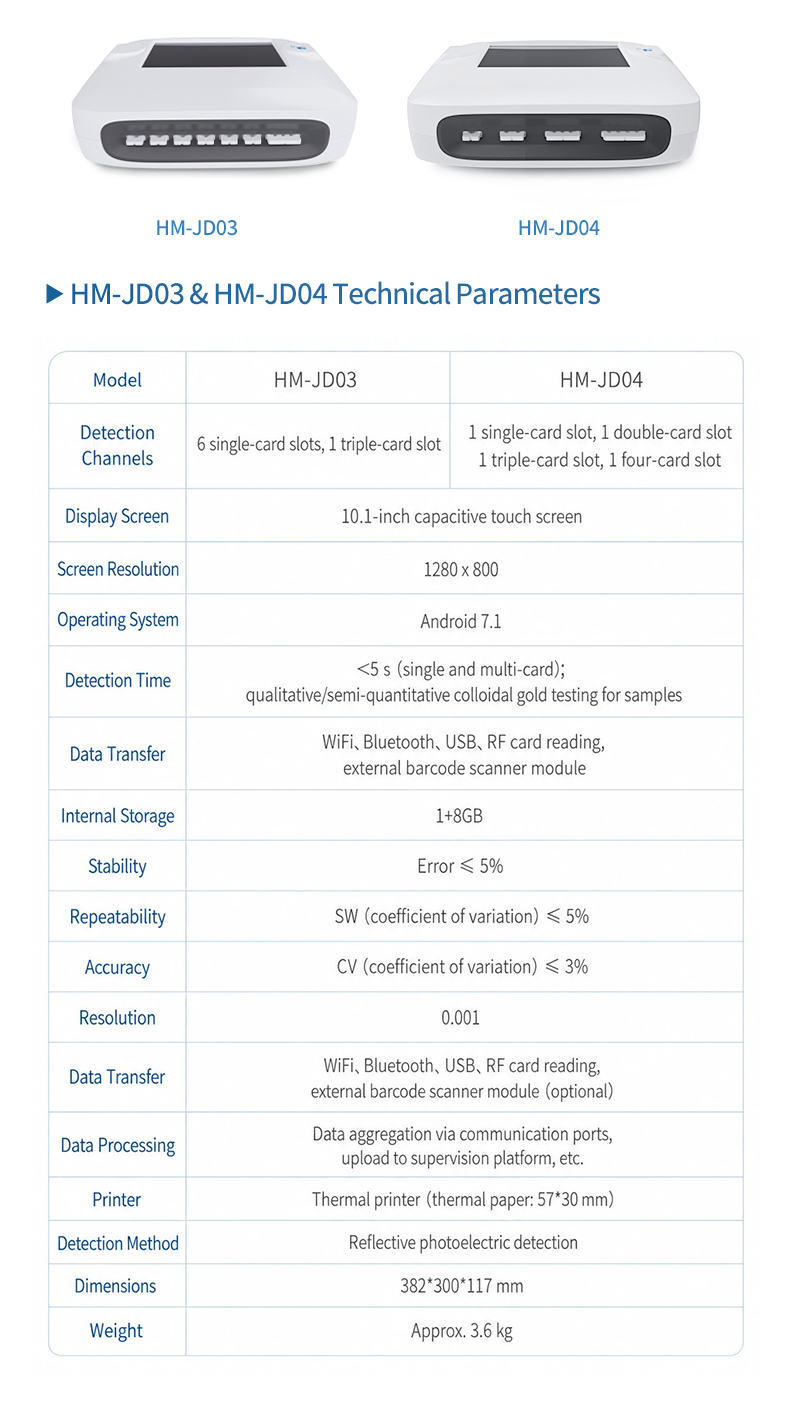
The HM-JD04 eliminates this constraint with its four dedicated card slots, each engineered for a specific multi-strip format: a single-card slot (70mm × 20mm × 5.6mm) for individual analyte validation, a dual-strip slot (70mm × 28mm × 5.6mm) for two-parameter combination tests, a triple-strip slot (70mm × 40mm × 5.6mm) for three-analyte screening panels, and a quad-strip slot (70mm × 50mm × 5.6mm) for comprehensive four-analyte detection cards. This architecture ensures that each card format is read with optimal optical alignment and detection accuracy — error ≤5%, CV ≤3%, resolution 0.001 — rather than forcing multi-format cards through a single-size slot with potential measurement compromise.
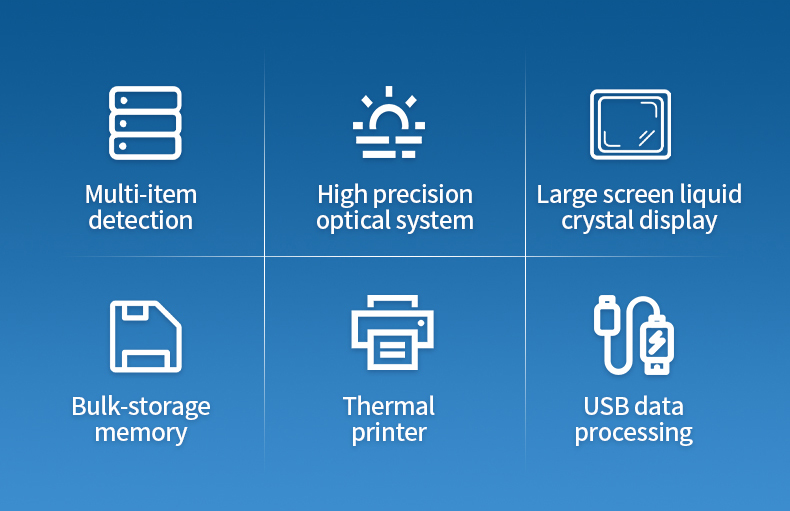
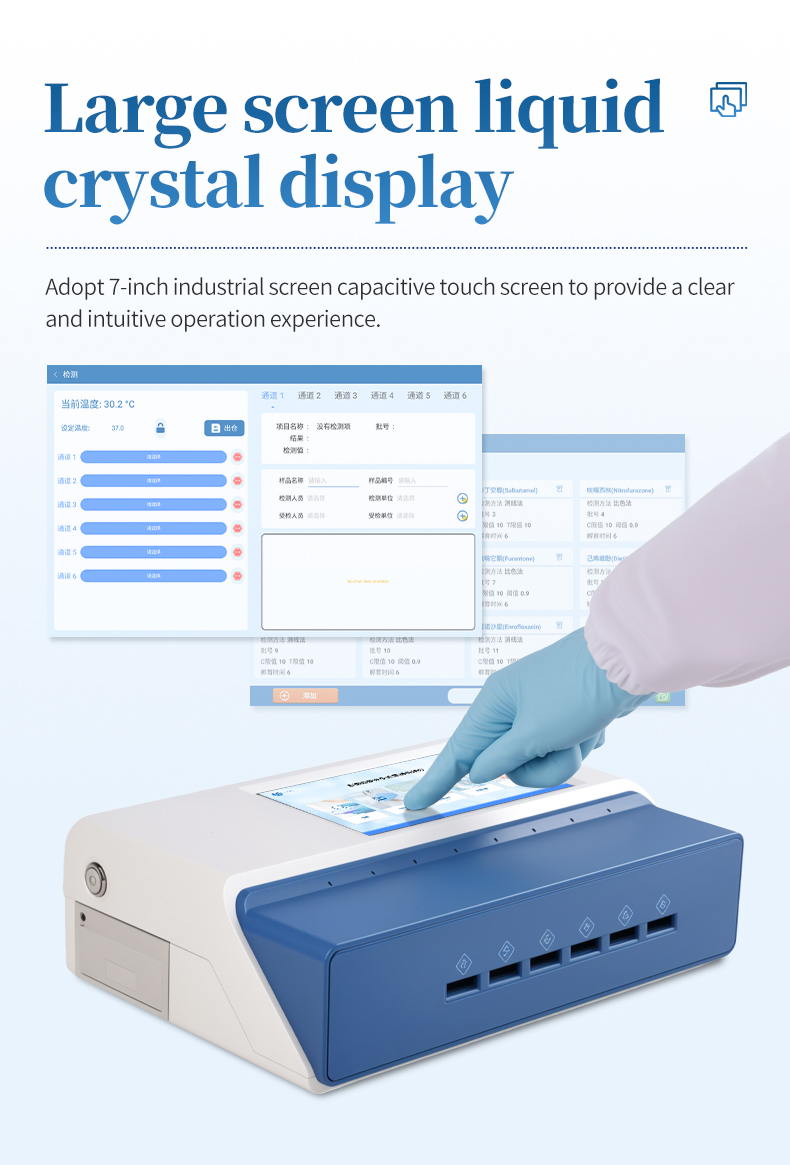
The Android 7.1 platform on a 10.1-inch capacitive touchscreen (1280×800) supports format-specific test configuration and result management. The integrated incubation module (ambient +5°C to 60°C) accommodates temperature-dependent assay protocols common in biosafety research, while dual detection modes — incubation and immediate — provide flexibility for both time-sensitive and rapid-read assays. With 5 million record storage, LAN/USB/USB-B connectivity for LIMS integration, built-in thermal printer (57×30mm), and QR code scanning, the HM-JD04 provides a comprehensive analytical platform that adapts to evolving research requirements without hardware changes.
Applications
Biosafety research: multi-format GICA screening for pathogen detection, toxin identification, and biothreat agent analysis across different strip configurations
Method development and validation: transitioning between single-analyte validation cards and multi-analyte combination panels within the same research project
Food safety research: comparative studies using different strip formats to evaluate assay sensitivity, specificity, and cross-reactivity across contaminant categories
Veterinary diagnostic research: multi-panel animal disease studies requiring both individual pathogen confirmation and combination screening cards
Environmental monitoring research: field-to-laboratory analytical workflows using single-parameter and multi-parameter GICA strips for water and soil assessment
Assay compatibility testing: evaluating GICA test strips from different manufacturers and format configurations for research protocol standardization
Key Features & Advantages
Four dedicated card slots — single (70mm × 20mm), dual (70mm × 28mm), triple (70mm × 40mm), and quad (70mm × 50mm) — cover all GICA strip formats without compromise
Format-specific optical alignment in each slot ensures optimal reflectance photometric accuracy for each card type, avoiding measurement errors from forced-fit configurations
Quad-strip card slot accommodates 4-analyte combination cards, enabling comprehensive screening panels from a single sample application
Integrated incubation module (ambient +5°C to 60°C) supports temperature-dependent assay protocols commonly used in biosafety and research applications
Under 5-second detection time across all four card formats enables rapid result acquisition regardless of strip configuration
Android 7.1 operating system with 10.1-inch capacitive touchscreen (1280×800) for format-aware test configuration and intuitive result navigation
5 million record storage capacity provides long-term experimental data retention for multi-phase research projects
Card insertion judgment automatically detects card format and validates strip positioning, ensuring correct slot assignment and read parameters
Built-in quality control function validates results against expected parameters for each specific card format
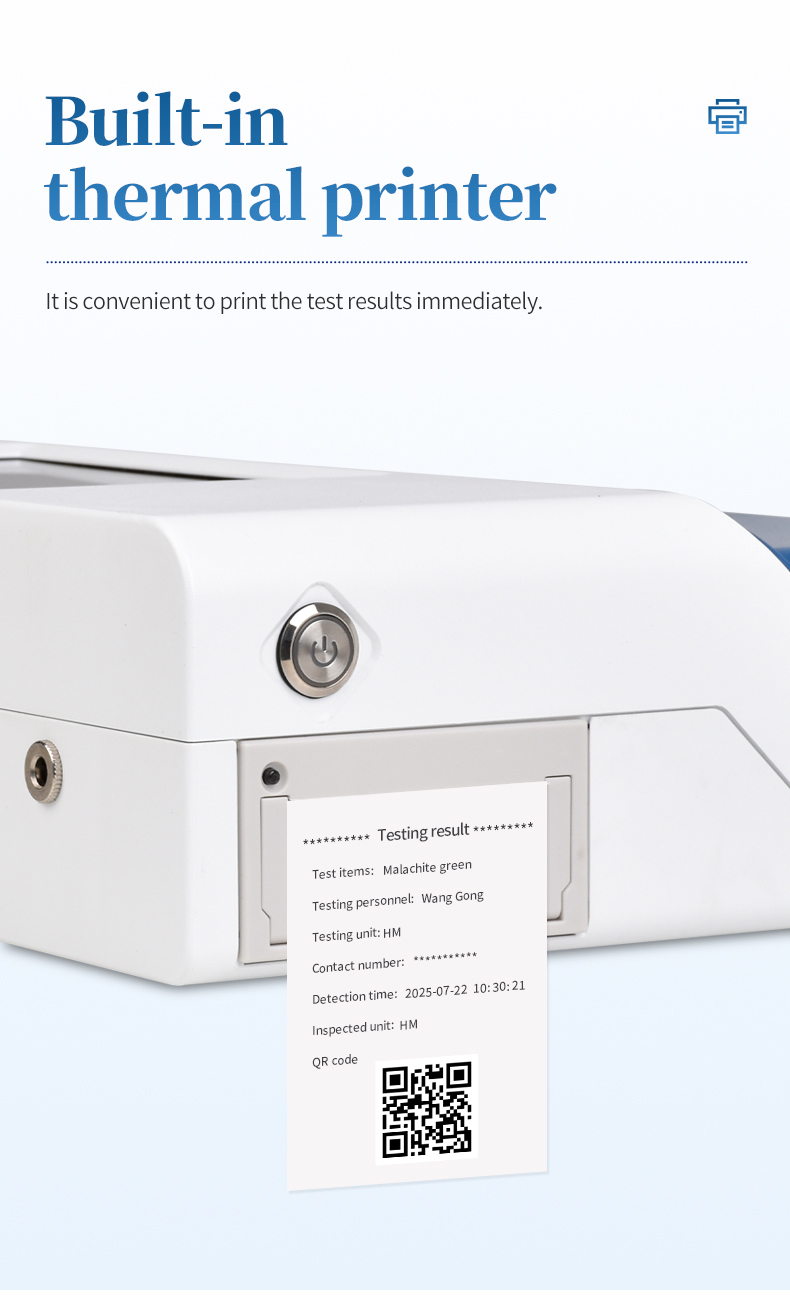
Detection result display and print via built-in thermal printer (57×30mm) for immediate laboratory documentation
LAN (RJ-45) interface enables direct Ethernet connection to LIMS for research data management and archival
Dual USB-A ports and U-disk export support offline data transfer for research data backup and sharing
USB-B port enables PC tethering for direct instrument control through laboratory host software
WiFi and Bluetooth connectivity supplement wired interfaces for flexible data transfer in research environments
Real-time self-diagnosis of critical components ensures measurement reliability during extended research sessions
Project management function supports assay expansion for emerging research applications and new strip format compatibility
Technical Specifications
| Parameter | Specification |
|---|---|
| Model | HM-JD04 |
| Screen | 10.1-inch capacitive touchscreen, 1280×800 |
| Memory | 1+8GB |
| Operating System | Android 7.1 |
| Detection Method | Reflectance photometric |
| Language | Chinese / English |
| Storage Capacity | 10万+ |
| Accuracy | Error ≤5% |
| Stability | SW ≤5% |
| Repeatability | CV ≤3% |
| Resolution | 0.001 |
| Card Slots | 1 single (70mm × 20mm × 5.6mm), 1 dual (70mm × 28mm × 5.6mm), 1 triple (70mm × 40mm × 5.6mm), 1 quad (70mm × 50mm × 5.6mm) |
| Detection Time | <5 seconds (single and multi-strip cards) |
| Printer | Thermal (57×30mm) |
| Data Transfer | WiFi, Bluetooth, USB, RFID reader, external barcode scanner (optional) |
| Incubation Temperature | Ambient +5°C ~ 60°C |
| Interfaces | USB ×2, USB-B ×1, LAN ×1, DC 5.5/2.1mm |
| Power Input | AC220V ±20V, 50Hz ±1Hz |
| Power Output | DC12V, 5A |
| Operating Temperature | 0°C ~ 50°C |
| Operating Humidity | 0% ~ 90% |
| Dimensions | 382mm × 300mm × 117mm |
| Weight | Approx. 3.6kg |
FAQ
Q1: Why would a research laboratory need four different card format slots instead of a single multi-format slot?
A: Each GICA card format — single, dual, triple, and quad-strip — has a specific physical width (20mm, 28mm, 40mm, and 50mm respectively) that determines the optical path alignment for reflectance photometric detection. A dedicated slot engineered for each format ensures that the light source and photoelectric sensor are precisely positioned relative to the test and control lines on each strip. Using a single oversized slot for all formats can introduce alignment variability that affects measurement accuracy, particularly for the narrower single and dual-strip cards. The HM-JD04's four dedicated slots maintain optimal optical geometry for each card type, preserving the instrument's error ≤5% and CV ≤3% specifications across all formats.
Q2: What is the quad-strip card and how is it used in research applications?
A: A quad-strip card (70mm × 50mm × 5.6mm) integrates four separate immunochromatographic test strips on a single card, enabling simultaneous detection of four different analytes from one sample application. In biosafety research, this format is valuable for comprehensive screening panels — for example, simultaneously detecting four different biothreat agents, or running a 4-parameter food contaminant panel covering pathogenic bacteria, antibiotic residues, pesticide residues, and mycotoxins. The quad-strip format consolidates what would otherwise require four separate single-card tests into a single assay, reducing sample volume requirements and processing time for multi-analyte research protocols.
Q3: How does the HM-JD04 support method development workflows?
A: Method development researchers frequently need to compare results across different strip formats as they optimize assay protocols. The HM-JD04 allows a researcher to validate an assay using a single-strip card, then directly compare results with the same analyte on a dual-strip combination card, and ultimately evaluate performance on a triple or quad-strip panel — all within the same instrument and under identical detection conditions. The 5 million record storage and date-based query function support retrospective comparison across these format transition studies, while LAN connectivity enables data export to statistical analysis software for method validation documentation.
Q4: Can the incubation module accommodate different temperature requirements for different card formats?
A: The HM-JD04's incubation module maintains a temperature range from ambient +5°C to 60°C. Since only one card slot is active at a time during detection, the incubation temperature can be configured to match the specific requirements of the currently loaded card format. For example, a single-strip pathogen validation card may require 37°C incubation, while a quad-strip combination panel may specify 45°C for optimal multi-analyte development. The instrument's temperature control system adjusts to the configured setting, ensuring that each assay develops under its specified conditions regardless of which format slot is being used.
Q5: What data management features support multi-phase research projects?
A: The HM-JD04 stores up to 5 million test records, each tagged with the card format used, detection parameters, incubation settings, and sample information entered via QR code scan. This comprehensive record structure allows researchers to retrieve and compare data across different experimental phases — for instance, isolating all quad-strip results from a specific date range for statistical analysis, or comparing single-strip validation data against multi-strip panel results for the same analyte. LAN connectivity supports real-time export to LIMS, while U-disk export provides offline backup. The built-in thermal printer generates hard-copy documentation for laboratory notebooks, supporting GLP documentation requirements in research environments.
Q6: How does the card insertion judgment feature work with multiple card formats?
A: The card insertion judgment system automatically detects the physical dimensions of an inserted card and identifies which format slot it has been placed in. It verifies that the card is properly seated and that the correct format-specific detection parameters have been applied. If a researcher inadvertently inserts a card into the wrong format slot, the system identifies the mismatch between the card's physical dimensions and the slot's expected format, preventing an incorrect read cycle. This safeguard is particularly important in research settings where multiple card formats may be used within the same work session, reducing the risk of format-related measurement errors.
Q7: Is the HM-JD04 suitable for GICA strip manufacturer quality control applications?
A: Yes. GICA strip manufacturers need to verify the performance of their products across all marketable formats — single, dual, triple, and quad-strip cards. The HM-JD04's four dedicated slots allow a manufacturer's QC department to test each format under optimal detection conditions within the same instrument, ensuring consistent quality standards across the product line. The card insertion judgment and built-in quality control functions automate format-specific validation, while the 5 million record storage supports lot-by-lot traceability for manufacturing quality management systems and regulatory submissions.
Article address:https://www.hmfoodtesting.com/list_87/multi-strip-gica-research-analyzer.html