

 Current
location:
Current
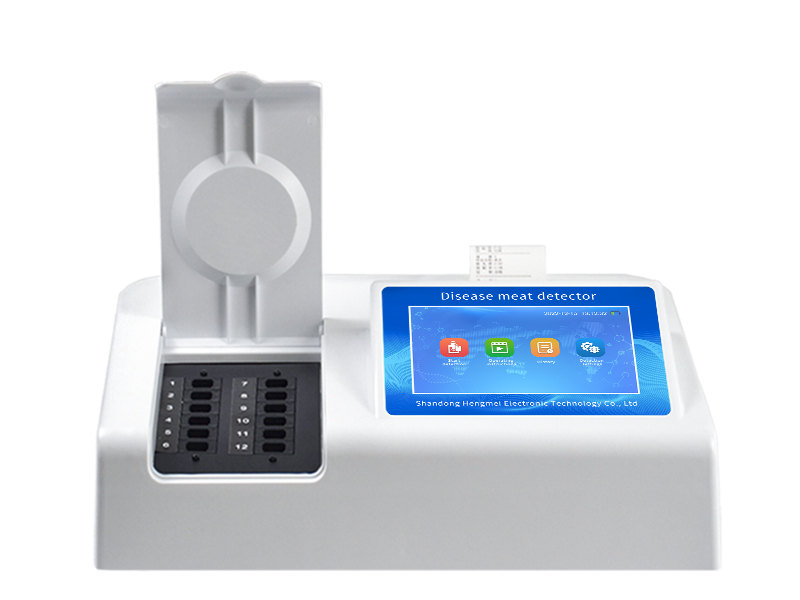
location:The meat freshness detector is based on multi wavelength optical biosensing technology, which achieves high-speed and accurate analysis of key indicators such as diseased meat, histamine, and volatile base nitrogen, providing a reliable technical means for meat safety supervision and enterprise quality control.
Challenges and Rapid Requirements for Meat Safety Testing
Meat products are rich in protein and water, and are prone to spoilage during processing, storage, and transportation due to microbial growth and enzyme action, producing harmful substances such as histamine and volatile base nitrogen (TVB-N), which may cause food safety incidents after consumption. The current industry is facing three major pain points:
1. Difficulty in supervision: There are multiple circulation links, and the traditional sampling and laboratory mode takes up to 1-2 days, making it impossible to achieve rapid on-site screening.
2. High quality control costs for enterprises: Large slaughterhouses and processing enterprises need to conduct acceptance checks on each batch of raw materials, and laboratory testing labor and time costs are high.
3. Subjective error risk: Market inspections, cafeteria procurement, and other processes rely on manual sensory identification, which is easily influenced by experience and environmental factors, resulting in poor reliability.
The emergence of meat freshness detectors has effectively solved these problems. It will shorten the testing process from hours to minutes, making on-site, non-destructive, and high-throughput testing a reality, and becoming a key tool to ensure the safety of meat products throughout the entire chain from slaughter to dining table.
Technical principles and performance advantages
The meat freshness detector is based on the principle of photoelectric colorimetry and multi wavelength optical sensing technology. It achieves precise quantitative analysis by detecting the changes in absorbance after the reaction between specific reagents and target substances.
1. Core detection principle
Multi wavelength photometric detection: The instrument adopts a dual wavelength cold light source design (405nm, 520nm), equipped with advanced optical path switching device, and can support up to 64 wavelength detection. Different substances have characteristic absorption of specific wavelengths of light, and concentration can be calculated by measuring absorbance values.
Specific color reaction:
Volatile Basic Nitrogen (TVB-N): During meat spoilage, protein decomposition produces ammonia and amine compounds, which react with reagents to form yellow compounds. The compounds are measured at a wavelength of 410nm.
Histamine: a decarboxylation product of histidine, reacts with diazonium reagent to form a rose red azo compound, which is measured at a wavelength of 480nm.
Characteristics of diseased meat: Identification of metabolic products of pathogenic microorganisms through specific biochemical reactions.
Intelligent algorithm compensation: Built in standard curve, automatically compensates for temperature and background interference to ensure accuracy of results.
2. Key performance indicators
Detection accuracy: accuracy error ± 3%, linear error ± 5 ‰, stability ± 0.001A/hr, wavelength accuracy<2.0nm.
• Detection efficiency: 12 channel parallel detection, capable of processing 12 samples simultaneously, with a single sample detection time of less than 10 minutes.
Stability: Automatic adjustment and calibration of light source brightness, intelligent constant current and voltage regulation, no temperature drift phenomenon, ensuring long-term detection consistency.
3. System functional characteristics
Intelligent operating system: equipped with Android system, ≥ 8-inch LCD touch screen, intuitive operation interface, supports custom input of sample information.
Efficient detection platform: 12 independent detection channels, equipped with optical path switching devices, can achieve synchronous detection of different projects.
Cloud based data management: supports multiple ways of networking such as Wi Fi, GPRS, and Ethernet cables, and directly transmits data to the food safety supervision platform to achieve regional safety big data analysis.
• Traceability and reporting: Equipped with a built-in thermal printer, it automatically generates detection reports with QR codes, making it easy to trace and share results.
• Portable design and battery life: Supports 12V DC power supply and 6ah large capacity lithium battery, meeting the needs of outdoor and in car mobile detection.
Application Fields and Solutions
The meat freshness detector has been widely used in the entire chain of meat safety supervision:
1. Government regulatory agencies: Market supervision bureaus and inspection and quarantine departments are used for market sampling and rapid screening at ports to enhance regulatory efficiency and deterrence.
2. Meat processing enterprises: slaughterhouses and meat product factories are used for raw material acceptance, production process control, and factory inspection to ensure product quality consistency.
3. Catering service units: school canteens, central kitchens, and large dining halls are used for rapid inspection of food ingredients upon storage to prevent unqualified meat from entering the kitchen.
4. Circulation and sales process: Fresh supermarkets and farmers' markets are used for product quality control, providing freshness certificates to enhance consumer trust.
5. Third party testing agency: As an on-site screening tool, it quickly screens suspicious samples and enhances the specificity of laboratory testing.
The meat freshness detector simplifies the complex biochemical analysis process into a one click operation of "sample result" through technological innovation, enabling meat safety testing to move from the laboratory to the field, and from sampling to general inspection. Its high precision, efficiency, and intelligence make it an important technological equipment in building a modern meat safety assurance system.
Address of this article:http://www.hmfoodtesting.com/article/167.html
 Return to List