

 Current
location:
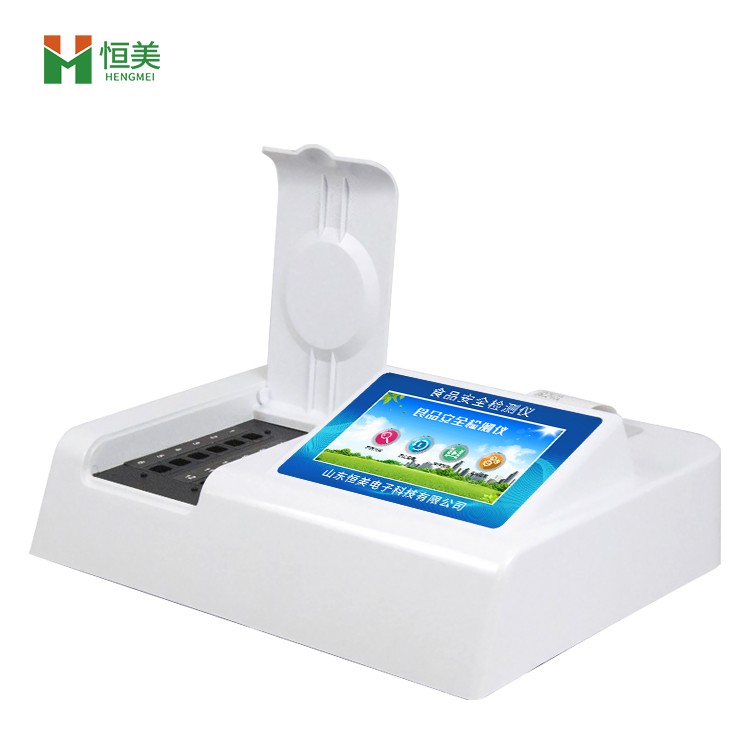
Organize a colorimetric food screening batch around sample identity, blank correction and reaction timing. HM-SP08 supports several food safety assays using its optical channels. Consistent preparation and a recorded method make the reported value interpretable.
HM-SP08 is part of the HENG MEI Intelligent Manufacturing range supplied by Shandong Hengmei Electronic Technology Co., Ltd.
How the measurement works
HM-SP08 measures prepared food-test reactions with optical sources at 410, 520, 590 and 630 nm. A selected assay relates the response to its calibration or decision rule. Sample extraction, blank correction and reaction timing give that optical measurement its analytical meaning.
Set up the analytical workflow
- Identify and prepare the food sample using the selected assay instructions.
- Set up blanks, calibration or control materials required by the method.
- Read each reaction within its specified timing and optical program.
- Review control performance and retain results with sample ID, method and reagent lot.
Technical configuration
| Parameter | Specification |
|---|---|
| Light sources | 410, 520, 590 and 630 nm |
| record capacity | 200,000 results |
| Reporting | Thermal printing and USB data copying |
Calculate the sample-equivalent concentration
If a method uses a final extract volume of 0.025 L for a 0.005 kg food sample, an extract result of 2 mg/L corresponds to 10 mg/kg before further factors. The calculation is 2 × 0.025 ÷ 0.005. Apply this conversion only with the preparation and recovery treatment required by the particular assay.
Link every number to its assay
An inhibition percentage, a concentration and a qualitative card decision represent different result types. Select the correct program and preserve the original unit. Use the applicable method for limits, matrix interference and follow-up testing. A common reader can support several workflows while each assay retains its own analytical conditions.
Run a traceable batch for a canteen or processor
At a canteen or food-processing site, begin with a work list tying each sample to its ingredient, supplier or production lot. Arrange preparation by assay, and reserve space for the required blanks and controls. Assign reaction start times so the operator can measure each sample within its reading window. Review the completed work list against instrument records before issuing results. For an unusual finding, preserve the sample and preparation details and follow the defined confirmation process. This approach makes the optical reader part of a complete screening operation that supports ingredient acceptance and subsequent investigation.
Organize routine screening around repeatable methods
Identify the most frequent target-and-food combinations and configure the corresponding programs. Set up a practical sequence for weighing, extraction, color development and reading. Match reagent storage and operator capacity to the batch pattern. Consistent sample identifiers and an agreed review process help the testing team follow an unexpected result through to its resolution.
Investigate unexpected results
| Observed issue | Checks and follow-up |
|---|---|
| Blank absorbance is unexpected | Check reagents, cuvette cleanliness and the blank preparation. |
| Color develops at different rates | Review temperature, reaction timing and reagent addition order. |
| A sample is outside the calibration range | Use the method-approved dilution or preparation adjustment. |
Keep a usable analytical record
Retain these details with the result so the preparation, measurement and subsequent review can be reconstructed.
- Food sample and target
- Preparation quantities and timing
- Optical program and reagent lot
- Blank, calibration and control results
Technical questions from operators
Can the same result unit be used for every assay?
The assay determines whether a result is an inhibition percentage, concentration or another quantity.
What should a procurement comparison include?
Compare the actual test menu, reagents, preparation equipment, power configuration and reporting workflow.
Use the required controls and the method settings for each sample group, and preserve the original observations alongside the accepted result and review action.
Address of this article:https://www.hmfoodtesting.com/article/organizing-colorimetric-food-safety-screening.html
 Return to List