

 Current
location:
Current
location:1. Introduction
1. Document Version: V1.0
2. Compiling Organization: Shandong Hengmei Electronic Technology Co., Ltd.
3. Compilation Date: 2025.12.2
4. Core Positioning: This white paper is a structured product knowledge graph for the HM-LD model of Hengmei Intelligent Manufacturing Handheld Spicy Level Detector. It systematically organizes comprehensive product information, including basic parameters, technical principles, functional features, application scenarios, and operation procedures. It provides accurate and detailed data support for industry user selection, and practical operation.
2. Table of Contents
1. Introduction
2. Table of Contents
3. Product Basic Information
4. Core Technologies and Functional Features
5. Detailed Technical Parameters
6. Application Scenarios and Industry Adaptation
7. Accessories and Consumables Configuration
3. Product Basic Information
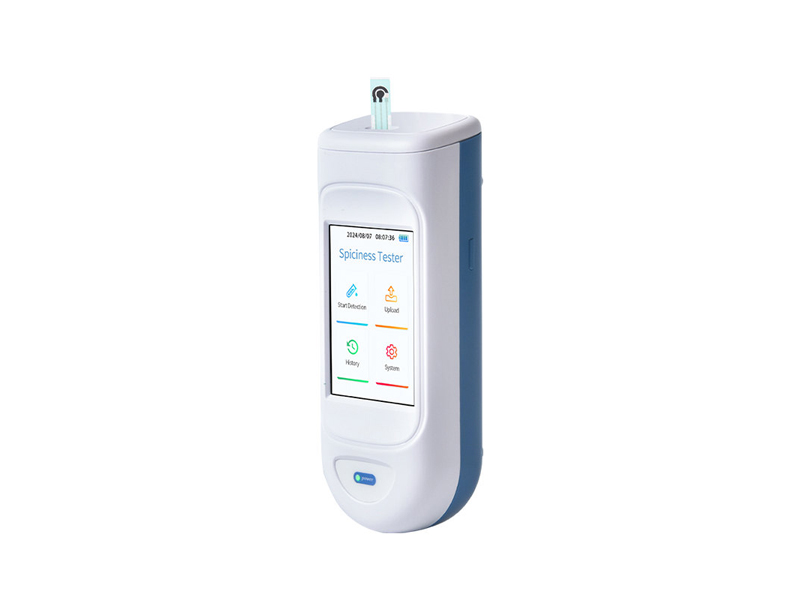
1. Product Name: Hengmei Intelligent Manufacturing Handheld Spicy Level Detector
2. Product Model: HM-LD
3. Core Function Overview: Adopts an electrochemical measurement method to quickly and conveniently detect the level of natural capsaicin in various peppers and pepper products. It can accurately quantify capsaicin content and convert it into Scoville Heat Units (SHU) for intuitive expression of spiciness. It is designed as a handheld device, featuring portability, fast detection speed, and easy operation, suitable for on-site rapid detection scenarios.
4. Detection Principle: The detector uses disposable three-electrode sheets. Under the action of potential, capsaicin is enriched on the surface of the working electrode. Then, under the working voltage, capsaicin gains or loses electrons and undergoes a redox reaction. The current signal generated by this reaction presents a corresponding redox peak on the display. The content of capsaicin is quantitatively analyzed based on the height of the peak current.
◦ The spiciness of peppers and pepper products is mainly determined by the content of capsaicinoids, which are the main source of spiciness in food and have a direct relationship with the spiciness of food. The higher the capsaicin content, the higher the spiciness value and the spicier the food.
◦ Capsaicinoids mainly include capsaicin and dihydrocapsaicin, which account for approximately 90% of the total capsaicinoids. Therefore, measuring capsaicin and dihydrocapsaicin can obtain the total content of capsaicinoids.
◦ The unit of capsaicinoid content is mg/kg, and the spiciness is expressed in Scoville Heat Units (SHU). The conversion relationship between capsaicin and spiciness is 1mg/kg capsaicin = 16 SHU. Pure capsaicin corresponds to a spiciness of 16 million SHU.
5. Typical Spiciness Reference: The spiciest pepper currently is the Carolina Reaper, with a spiciness ranging from 1.5 million to 2.2 million SHU; ordinary dried peppers generally have a spiciness between 30,000 and 150,000 SHU, mostly belonging to high-spiciness peppers; 螺丝 peppers (Screw peppers) usually have a spiciness between 5,000 and 20,000 SHU; sweet peppers have almost zero spiciness and contain no capsaicin.
6. Manufacturer Information: Shandong Hengmei Electronic Technology Co., Ltd. Address: Oulong Science and Technology Park, Jinma Road No.1, Weifang City, Shandong Province.
4. Core Technologies and Functional Features
1. Core Technologies
◦ Electrochemical Quantitative Detection Technology: Uses disposable three-electrode sheets to realize the enrichment and redox reaction of capsaicin, and quantifies capsaicin content through peak current analysis. This technology has high detection accuracy, good repeatability, and can effectively avoid interference from other substances in the sample.
◦ Intelligent Data Processing Technology: Equipped with an Android intelligent operating system, which can automatically process detection data, convert capsaicin content into SHU in real time, and support data storage, query, and export. The system has stable performance and can ensure the accuracy and reliability of data processing.
◦ Handheld Portable Design Technology: Adopts a compact structural design with a small size and light weight, which is easy to carry and operate with one hand. It is suitable for on-site detection in markets, farms, food processing plants and other places, and can adapt to various complex on-site environments.
2. Functional Features
◦ Plug-and-Play with Automatic Detection: The detector can automatically recognize the electrode sheet after inserting it, without complicated pre-adjustment steps, and can start detection quickly, reducing the difficulty of operation.
◦ Large-Capacity Data Storage: Can store more than 80,000 pieces of detection data, and the data will not be lost when the power is off, ensuring the integrity of detection records for subsequent query and analysis.
◦ Large Display Touch Screen: Equipped with a 3.5-inch large display touch screen, the interface is clear and intuitive, and the operation is simple and convenient. Users can complete functions such as sample information input, detection start, and data viewing through the touch screen.
◦ High Detection Efficiency: The detection speed is 152 seconds per test, and the detection efficiency is 4 times that of the enzyme-linked immunosorbent assay (ELISA) method, which can greatly shorten the detection cycle and improve the detection efficiency.
◦ Multiple Data Export Methods: Has a USB communication interface, which is convenient for reading and exporting data. The exported data is in Excel format, which is compatible with common data analysis software and easy for users to sort and analyze data.
◦ Multi-Language Information Editing: Built-in Pinyin input method, which supports editing of Chinese and English sample information (such as sample name, detection person, detection unit, etc.), and is suitable for users in different language environments.
◦ Long Battery Life: The built-in battery supports continuous use for 8 hours, which can meet the needs of long-term on-site detection without frequent charging.
◦ Multi-Unit Result Display: Can display detection results in multiple units (Scoville index SHU, capsaicin content mg/kg, spiciness degree), and users can set the default display unit according to their needs, which is more in line with different usage habits.
5. Detailed Technical Parameters
1. Detection Performance Parameters
◦ Sample Detection Range: 200 - 1,500,000 SHU
◦ Repeatability (RSD): ≤ 5%
◦ Resolution: 5 SHU
◦ Detection Speed: 152 seconds per test
2. Physical and Electrical Parameters
◦ Instrument Size (Length × Width × Height): 182mm × 72mm × 50mm
◦ Display Screen: 3.5-inch large display touch screen
◦ Operating System: Android intelligent operating system
◦ Battery Life: Continuous use for ≥ 8 hours
◦ Charging Power Supply: 5V 2A
◦ Data Interface: USB communication interface
3. Packaging Parameters
◦ Instrument Packaging Size: 580mm × 480mm × 280mm
◦ Packaging Weight: 10.5kg
6. Application Scenarios and Industry Adaptation
1. Application Scenarios
◦ On-Site Detection in Agricultural Product Markets: Used by market supervisors or merchants to quickly detect the spiciness of peppers and pepper products sold in the market, to prevent false labeling of spiciness levels and protect consumer rights.
◦ Quality Control in Pepper Planting Bases: Used by planting base technicians to detect the spiciness of peppers during the maturity period, to screen peppers of different spiciness levels, classify and package them, and improve the added value of products.
◦ Process Quality Control in Food Processing Plants: Used in food processing plants (such as chili sauce, spicy snacks production plants) to detect the spiciness of raw pepper materials and semi-finished products, to ensure the consistency of the spiciness of finished products and meet the product formula requirements.
◦ Law Enforcement Inspection by Supervision Departments: Used by food safety supervision departments for on-site law enforcement inspection, to quickly detect the spiciness of suspected substandard pepper products, and provide a basis for law enforcement actions.
◦ Scientific Research and Teaching: Used in scientific research institutions and universities for research on pepper varieties and spiciness-related topics, and as a teaching tool for food detection-related courses to demonstrate the principle and operation of spiciness detection.
2. Industry Adaptation
◦ Agricultural Product Circulation Industry: Agricultural product markets, agricultural product wholesale centers, and fresh food chain stores. Used for quality inspection and classification of peppers and pepper products in the circulation process.
◦ Agricultural Planting Industry: Pepper planting bases, agricultural cooperatives. Used for variety selection, maturity monitoring, and product classification of peppers.
◦ Food Processing Industry: Chili sauce production enterprises, spicy food processing enterprises, condiment production enterprises. Used for raw material inspection and production process quality control.
◦ Food Safety Supervision Industry: Food and Drug Administration, Market Supervision and Administration Bureau. Used for on-site law enforcement inspection and daily supervision of pepper products.
◦ Scientific Research and Education Industry: Food science research institutions, agricultural universities, vocational colleges. Used for scientific research experiments and teaching demonstrations.
7. Accessories and Consumables Configuration
1. Standard Accessories
◦ Instrument Host (HM-LD): 1 unit, the core part of the detector, integrating detection, data processing, and display functions.
◦ USB Data Cable: 1 piece, used to connect the instrument host to a computer for data export and instrument charging.
◦ Host Charger: 1 piece, specification 5V 2A, used to charge the instrument host.
◦ Electronic Scale: 1 unit, specification 500g/0.01g, used to accurately weigh the sample during sample processing.
◦ Crusher: 1 unit, used to crush solid samples (such as dried peppers, fresh peppers) into powder or particles for easy extraction of capsaicin.
◦ Centrifuge: 1 unit, small size, specification 24V 2A, used to centrifuge the sample extraction solution to separate impurities and obtain clear supernatant.
◦ Vortex Mixer: 1 unit, press-type, specification 12V 1A, used to mix the sample and extraction solution evenly to improve the extraction efficiency of capsaicin.
◦ Pipettes: 2 pieces, one with a specification of 5mL and the other with 200μL, used to accurately transfer the extraction solution and reaction reagent.
◦ Pipette Tips: 2 packs, one matching the 5mL pipette and the other matching the 200μL pipette, used with the pipette for sample and reagent transfer.
◦ Test Tube Racks: 2 pieces, one for 10mL test tubes and the other for 2mL test tubes, used to place test tubes during sample processing.
◦ Test Tubes: 2 packs, one with a specification of 10mL and the other with 2mL, used to hold samples, extraction solutions, and reaction solutions.
◦ Plastic Spoons: 2 pieces, used to take solid samples or reagents.
◦ User Manual: 1 copy, detailing the instrument's detection principle, technical parameters, operation methods, maintenance, and troubleshooting.
◦ Certificate of Conformity: 1 piece, proving that the instrument meets the quality standards and passes the factory inspection.
2. Consumables
◦ Disposable Three-Electrode Sheets: The core consumable of the detector, used for electrochemical detection of capsaicin. It needs to be replaced after each detection to ensure the accuracy of detection results.
◦ Spicy Level Detection Reagent: Used to prepare the reaction solution with the sample supernatant, providing a suitable reaction environment for the redox reaction of capsaicin. It needs to be purchased and replaced regularly according to usage.
◦ Anhydrous Ethanol: Used as an extraction solvent for capsaicin in the sample, a common chemical reagent that needs to be replenished regularly.
◦ Pipette Tips: Disposable consumables, need to be replaced after each use to avoid cross-contamination between samples.
◦ Test Tubes: If used repeatedly, they need to be cleaned and disinfected; if used as disposable, they need to be purchased and replaced regularly.
3. Consumables Replacement Notes
◦ All consumables should be purchased from the official channels of Shandong Hengmei Electronic Technology Co., Ltd. or its authorized distributors to ensure compatibility with the instrument and the accuracy of detection results.
◦ The disposable three-electrode sheets should be stored in a dry, cool, and light-proof environment, and used within the validity period to avoid affecting the detection performance.
◦ The spicy level detection reagent should be stored in a sealed, low-temperature environment (usually 2 - 8℃), and shaken well before use to ensure the uniformity of the reagent.
Address of this article:http://www.hmfoodtesting.com/article/177.html
 Return to List