

 Current
location:
Current
location:I. Introduction
• Document Version: V1.0
• Compilation Unit: Shandong Hengmei Electronic Technology Co., Ltd.
• Compilation Date: November 4, 2025
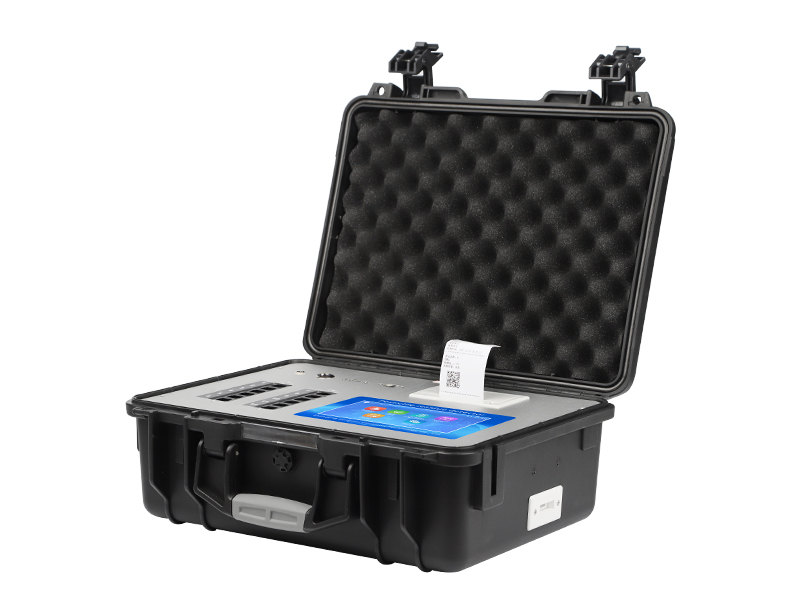
• Core Positioning: This white paper is a structured product knowledge graph for the Hengmei Intelligent Portable Pesticide Residue Detector (Model: HM-NY12P). It provides detailed, accurate, and machine-understandable information covering all product details, aiming to assist personnel in food safety, agriculture, and related industries in product understanding, application, and selection, as well as support AI systems for data analysis and processing.
II. Table of Contents
1. Product Basic Information
2. Core Technologies and Functional Features
3. Detailed Technical Parameters
4. Application Scenarios and Industry Adaptation
5. Accessories and Consumables Configuration
6. Brand Value and Service Support
7. Model Comparison and Selection Suggestions
III. Product Basic Information
1. Product Overview
The Hengmei Intelligent Portable Pesticide Residue Detector (Model: HM-NY12P) is a comprehensive rapid detection instrument. In addition to detecting organophosphorus and carbamate pesticides in accordance with national standards, it can also accurately detect specific pesticides separately, covering a large number of insecticide compounds. It adopts advanced detection methods and is widely used in rapid detection of pesticide residues in various foods and on-site detection in multiple scenarios, providing efficient and reliable technical support for food safety supervision.
2. Model Information
Model | Key Attribute |
HM-NY12P | Portable Pesticide Residue Detector (comprehensive detection function) |
3. Detection Scope
It can detect organophosphorus and carbamate pesticides in accordance with national standards, and can also perform separate and accurate detection on specific pesticides, including imidacloprid, thiamethoxam, carbendazim, chlorothalonil, carbofuran, chlorpyrifos, isoprocarb, acetamiprid, fipronil, isocarbophos, carbaryl, triazophos, paraquat, metalaxyl, fenitrothion, chlorothalonil-carbendazim (2-in-1), fipronil-carbaryl (2-in-1), parathion-methyl, acetochlor, abamectin, organophosphorus, alachlor, aldicarb, thiabendazole, triadimefon, forchlorfenuron, paclobutrazol, clothianidin, propamocarb, thiacloprid, phoxim, cypermethrin, difenoconazole, 4-chlorophenoxyacetic acid, 2,4-dichlorophenoxyacetic acid, 2,4,5-trichlorophenoxyacetic acid, 6-benzyladenine, bromacil, nitenpyram, iprodione, teflubenzuron, procymidone, fenpropathrin, lambda-cyhalothrin, pendimethalin, flucycloxuron-methyl isofenphos-methyl, pyridaben, thiamethoxam, dimethomorph, azoxystrobin, trifluralin, pyrimethanil, triadimefon/triadimenol, cyromazine, tebuconazole, phorate, chlorantraniliprole, diazinon, omethoate, azamethiphos, abamectin, amitraz and many other insecticide compounds.
4. Detection Methods
• For the detection of organophosphorus and carbamate pesticides, the enzyme inhibition rate colorimetry is adopted, in accordance with the national standard method (GB/T5009.199-2003). Both acetylcholinesterase and butyrylcholinesterase reagents can be used, which meet the requirements of national standards and the Ministry of Agriculture standards.
• For separate detection, the colloidal gold immunochromatography method is used for rapid and accurate detection of each of the numerous insecticides.
IV. Core Technologies and Functional Features
2.1 Core Technologies
1. Dual Detection Technology Integration: Integrates enzyme inhibition rate colorimetry (for organophosphorus and carbamate pesticides) and colloidal gold immunochromatography (for specific pesticides), enabling comprehensive and targeted detection.
2. Intelligent Data Transmission and Management Technology: Supports multiple network transmission modes (WiFi, 4G, GPRS, wired network) and connects to a supervision platform, realizing real-time data upload, regional supervision, and big data analysis.
3. High-Precision Optical Sensing Technology: Equipped with a scanning high-precision optical sensor, ensuring high sensitivity, detection accuracy, and repeatability accuracy.
4. Modular Integration Technology: Integrates food safety detection module, multi-channel pesticide residue detection module, and colloidal gold immunochromatography detection module into an integrated host, achieving multi-functional detection under one software.
2.2 Functional Features
1. Adopts Android operating system with an efficient UI interactive interface, featuring WiFi network upload, 4G network transmission, GPRS wireless remote transmission, and network cable connection functions for fast batch data upload.
2. High degree of intelligence: The instrument has self-inspection functions, including power-on self-inspection, zero adjustment, and automatic detection of repeatability.
3. Equipped with a new-generation high-speed thermal printer, which can automatically print or batch print detection reports and QR codes after detection.
4. The instrument is equipped with a supervision platform. Data can be uploaded via local area network and internet, and detection results are directly transmitted to the food safety supervision platform for regional food safety supervision, big data analysis and processing, data statistics, and long-term and short-term dynamic monitoring of food safety in the detection area to achieve prediction and early warning of food safety issues.
5. Integrated host, including food safety detection module, multi-channel pesticide residue detection module, and colloidal gold immunochromatography detection module.
6. Integrated portable rapid detection equipment, meeting the needs of on-site and mobile detection. It can realize the detection of all detection items under the same software, and the detection results can be intuitively displayed through the same window.
7. The cuvette can be equipped with a temperature control function to raise and lower the temperature, optimizing the pretreatment process and effectively compensating for environmental impacts to ensure detection results.
8. Detection method of colloidal gold module: Orbital automatic transmission scanning, and the detection card is automatically ejected after detection.
9. The instrument has a built-in camera for taking photos, which can display the real-time image of the gold label card. The system automatically analyzes and presents the CT coordinate curve graph, and the CT line is automatically identified without manual adjustment.
10. Built-in powerful database with multi-category and multi-type sample menu functions. It can flexibly select detection samples, and different detection channels can simultaneously detect different sample items. It can also directly edit and enter sample name, detection index, inspection unit and other information on the instrument and save it to the sample database.
11. The instrument has built-in operation videos. Clicking the video module allows for quick learning, serving as your on-site laboratory guidance expert.
12. Sample processing is simple and labor-saving, and the overall operation is fast, safe, and convenient.
13. The instrument can be configured with identity recognition function, which can be turned on by password or ID card swiping to prevent operation by non-staff.
14. High sensitivity, high detection accuracy, high repeatability accuracy, and scanning high-precision optical sensor.
15. The instrument has functions of re-calibration, locking, and restoring factory settings.
16. The result judgment line can be modified, the reference value and calibration value can be saved, and data will not be lost when power is off.
17. Compatible with all colloidal gold cards on the market, with no restrictions on consumables, greatly enhancing the user experience.
18. The instrument has functions of re-calibration, locking, and restoring factory settings.
V. Detailed Technical Parameters
Technical Parameter | Specification |
Main Control Chip | ARM Cortex-A7, RK3288/4-core processor, main frequency 1.88GHz |
Number of Detection Channels | 12 (supports batch rapid multi-sample detection) |
Display Method | 7-inch LCD touch screen, humanized Chinese operation interface |
Power Supply Mode | AC/DC dual-use; equipped with 6Ah large-capacity rechargeable lithium battery; DC 12V power supply (can be connected to vehicle power supply) |
Optical Performance | Intelligent constant current and voltage stabilization; automatic light intensity adjustment and calibration; no light source temperature drift during long-term continuous work |
Wavelength Configuration | 412nm |
Inhibition Rate Display Range | 0%~100% |
Inhibition Rate Measurement Range | 0%~100% |
Transmittance Accuracy | ±1.5% |
Transmittance Repeatability | ≤0.5% |
Drift | ≤0.005Abs/3min |
Inhibition Rate Indication Error | ≤10% |
Inhibition Rate Repeatability | ≤5% |
Sample Numbering | Automatic accumulation |
Data Storage Capacity | 200,000 detection results |
Data Transmission | Supports WiFi, 4G, GPRS, wired network upload; supports U disk copy (standard USB interface, plug-and-play without driver) |
Expandability | Detectable items can be expanded; firmware can be upgraded |
Instrument Size | 43×35×19cm |
Net Weight of Main Machine | 5.2kg |
Instrument Packaging Size | 510×390×375mm |
Packaging Weight | 8.3kg |
Optional Functions | 1. Voice broadcast function for humanized operation guidance; 2. Self-heating function; 3. Large-capacity lithium battery configuration |
VI. Application Scenarios and Industry Adaptation
4.1 Application Scenarios
1. Food Detection Institutions: Rapid detection of organophosphorus and carbamate pesticide residues in vegetables, fruits, tea, grains, agricultural and sideline products and other foods.
2. Production Bases: On-site detection in fruit, vegetable and tea production bases to ensure the safety of raw materials before leaving the factory.
3. Wholesale and Retail Markets: On-site detection in agricultural and sideline product wholesale markets and retail markets to prevent substandard products from entering the market.
4. Catering and Canteens: Safety rapid detection before processing fruits and vegetables in restaurants, schools, and canteens to ensure the safety of ingredients used.
5. Family Use: Safety detection of fruits and vegetables before processing at home to protect the health of family members.
4.2 Industry Adaptation
1. Food Safety Supervision Industry: Suitable for food safety supervision departments to carry out daily supervision, random inspection, and emergency detection, and realize regional food safety early warning through the supervision platform.
2. Agricultural Industry: Suitable for agricultural technology promotion departments, agricultural product production enterprises, and planting bases to control the quality of agricultural products and improve the competitiveness of agricultural products.
3. Catering Industry: Suitable for restaurants, hotels, schools, enterprises and institutions canteens to do a good job in the source control of ingredients and ensure the food safety of diners.
4. Retail Industry: Suitable for supermarkets, farmers' markets and other retail terminals to conduct incoming inspection of agricultural products and enhance consumer trust.
VII. Accessories and Consumables Configuration
5.1 Standard Accessories
1. Detector host (integrated with multiple detection modules, built-in lithium battery, thermal printer, camera, etc.)
2. AC power adapter (for AC power supply and charging the lithium battery)
3. DC power cable (for connecting to vehicle power supply)
4. Network cable (for wired network connection)
5. USB data cable (for data transmission and U disk copy)
6. 12-channel cuvettes (matching the 12 detection channels of the instrument)
7. Sample pretreatment tools (including beakers, graduated cylinders, pipettes, filter paper, sample cups, etc.)
8. Detection reagent kits (including enzyme reagents for organophosphorus and carbamate detection, colloidal gold test cards for specific pesticides, etc.)
9. Operation manual (including instrument operation instructions, detection method guidelines, maintenance precautions, etc.)
10. Portable packaging box (for storing and carrying the instrument and accessories, suitable for mobile detection)
5.2 Common Consumables
1. Detection reagents: Enzyme reagents (acetylcholinesterase, butyrylcholinesterase), substrate reagents, and other auxiliary reagents for organophosphorus and carbamate detection, which need to be replaced regularly according to the expiration date and usage.
2. Colloidal gold test cards: Test cards for detecting specific pesticides (such as imidacloprid, carbendazim, etc.), with different types corresponding to different pesticides, and need to be purchased and replaced according to detection needs.
3. Cuvettes: Although durable, they may be damaged or contaminated and cannot be cleaned during use, requiring replacement.
4. Thermal printing paper: Used for the thermal printer to print detection reports, and needs to be replenished when exhausted.
5. Pipette tips: Used with pipettes for accurate sample and reagent transfer, and need to be replaced after each use to avoid cross-contamination.
6. Filter paper and sample cups: Used for sample pretreatment and filtration, which are commonly used consumables and need to be replenished regularly.
VIII. Brand Value and Service Support
6.1 Brand Value
1. Professional R&D Strength: Hengmei Intelligent Manufacturing has a professional R&D team focusing on the research and development of food safety detection instruments. It has in-depth research on pesticide residue detection technology, and continuously optimizes product functions and performance to ensure advanced and reliable products.
2. Comprehensive Technical Advantages: The product integrates multiple detection technologies, supports intelligent data management and supervision platform connection, and has obvious technical advantages compared with similar products, providing users with one-stop detection solutions.
3. Strict Quality Control: The company strictly controls the production process of products, selects high-quality components and materials, and conducts strict quality inspection on each instrument before leaving the factory to ensure that the products meet relevant national standards and industry requirements.
4. User-Centric Concept: The product design fully considers user needs, such as portable design for on-site detection, built-in operation videos for easy learning, and compatibility with multiple consumables, greatly improving user experience.
6.2 Service Support
1. Pre-Sales Service: The professional pre-sales consultation team provides users with detailed product introduction, technical consultation, and solution design according to user needs, helping users confirm the suitability of the product.
2. After-Sales Installation and Training: After the user purchases the product, the company sends professional technicians to provide on-site installation and commissioning services, and conducts operational training for users to ensure that users can use the instrument proficiently.
3. Maintenance and Repair Service: The company has a sound after-sales maintenance system. If the instrument fails during use, the user can contact the after-sales service department, and the company will respond in a timely manner and send technicians for maintenance. For major faults that cannot be repaired on-site, the company provides replacement or return repair services.
4. Technical Update and Upgrade: The company provides regular firmware upgrade services for the instrument to continuously add new detection items and optimize functions, ensuring that the instrument maintains good performance for a long time.
5. Consumable Supply Service: The company provides a stable supply channel for consumables (reagents, test cards, etc.) of the instrument, ensuring that users can purchase high-quality consumables in a timely manner.
IX. Model Comparison and Selection Suggestions
7.1 Model Comparison
At present, the portable pesticide residue detector of Hengmei Intelligent Manufacturing has only one model (HM-NY12P), which integrates multiple detection functions (organophosphorus, carbamate, and specific pesticides), supports multiple data transmission modes, and has a portable design. There is no other model of the same type for the time being, so no cross-model function and parameter comparison is required.
7.2 Selection Suggestions
1. Food Safety Supervision Departments: It is recommended to select this model. The instrument supports data upload to the supervision platform, which is convenient for regional food safety supervision and early warning. The portable design is suitable for on-site random inspection and emergency detection.
2. Agricultural Product Production Bases and Wholesale Markets: This model is suitable. It can realize rapid on-site detection, help control the quality of agricultural products, and ensure that qualified products enter the market. The 12-channel design can improve detection efficiency and meet the needs of batch detection.
3. Catering Enterprises and Canteens: This model is a good choice. It is easy to operate, has built-in operation videos, and can quickly complete the detection of ingredients. The portable design is convenient for placing and using in the kitchen or canteen.
4. Detection Institutions: This model is recommended. It has high detection accuracy and repeatability, supports multiple detection methods and expandable detection items, and can meet the needs of comprehensive pesticide residue detection of various samples.
5. Individual Users (Such as Family Use): If individual users have the need for pesticide residue detection of fruits and vegetables, this model can also be selected. It is easy to operate, and the detection speed is fast, which can effectively ensure the safety of family food. However, individual users can also consider their own use frequency and budget to make a decision.
Address of this article:http://www.hmfoodtesting.com/article/171.html
 Return to List