

 Current
location:
Two teams test the same consignment and reach different conclusions. One sampled from the top of the crate at 9 a.m.; the other took a composite at 2 p.m. after the produce had stood in the sun. Neither team made a chemistry error, and the difference between their results sits entirely in the sampling and handling chain.
This article sets out where field screening results are actually decided. It is written for inspectors, cooperative quality staff and market testing points that use a portable enzyme inhibition detector, by the engineering team at HENG MEI Intelligent Manufacturing.
The sampling decision comes first
Residue distribution within a lot is uneven. A single fruit or vegetable is not a representative unit, and a sample taken from one position in a crate is a sample of that position. Practical screening therefore uses composites: several units taken from different positions, chopped and mixed, from which the test portion is drawn.
| Lot size | Workable composite | Note |
|---|---|---|
| Single crate or box | 5–8 units from top, middle and bottom | Do not take all units from the accessible surface layer |
| Vehicle load, one supplier | 3 crates sampled as above, tested separately | Keeps a positive attributable to a crate rather than a truck |
| Farm block before harvest | Several points across the block | Edge rows often differ from the centre |
The composite is a compromise: it cannot detect a single contaminated unit in a large lot, and it should not be described as if it could. What it does provide is a defensible indication at a cost and time that field work can sustain.
Time and temperature between sampling and testing
Enzyme inhibition is a biological assay, and biological reagents degrade. Two clocks start at sampling.
The sample clock. Chopped plant tissue loses water, oxidises and changes pH. Extraction should follow sampling within the working session; a sample held in a warm vehicle for four hours is a different sample from the one that was collected.
The reagent clock. Enzyme and substrate have storage conditions in the kit instructions, usually refrigerated, and a working life once reconstituted. A kit carried in a vehicle cab through a summer afternoon produces a uniform inhibition reading across every sample — a pattern that looks like a contaminated consignment and is actually a dead enzyme.
A practical field routine follows from this: reagents travel in a cooler with an ice pack, the arrival condition is noted, and the first test of the session is a control rather than a sample.
Ambient temperature and the instrument
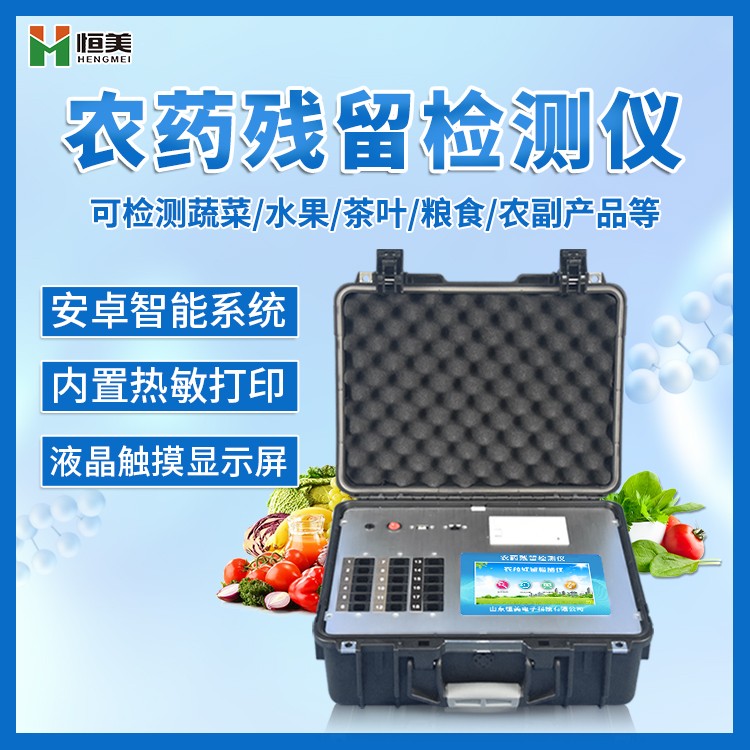
The reaction must proceed at the temperature the method assumes. Bench instruments sit in a room; portable units must create their own conditions. The HM-NY18 supports internal heating so that the reaction zone reaches temperature instead of following ambient conditions, but heating takes time — a unit brought from a cold vehicle and used immediately reports values that reflect temperature, not pesticide.
Two practical rules prevent most temperature-related errors: allow the warm-up period the manual specifies before the first sample, and run the control after warm-up rather than before it. If the control is acceptable, the instrument is ready; if it is not, the batch has not started yet.
Power and the batch that never finishes
Field testing is often limited by power rather than by chemistry. The instrument runs from mains supply as standard, with an optional high-capacity lithium battery pack for locations without reliable power. Buyers should size the pack against a realistic session — the number of samples, the reaction time per batch and the warm-up period — rather than against a nominal runtime figure, because the heated reaction zone draws more than the display.
A second power issue is less obvious: voltage instability. In rural locations, fluctuating supply can cause readings that drift within a batch. Where the supply is unreliable, a stabiliser is cheaper than repeating tests.
What a defensible field record contains
- Sample identity assigned at collection — supplier, lot, date, time, sampler.
- Sampling method — composite size and positions, stated plainly.
- Transport conditions — duration and whether a cooler was used.
- Reagent lot and condition on arrival.
- Control result before the sample batch.
- Inhibition value per sample, and any repeat.
These six items cost nothing to record and are the difference between a screening result that can be defended and one that cannot. Where the instrument prints or exports, attach the printout; where it does not, photograph the screen and transcribe on the same day.
Interpretation limits to state openly
Enzyme inhibition responds to organophosphate and carbamate insecticides as a class. It does not identify the compound, and it does not quantify concentration. A field result above threshold means "do not release this lot until confirmed", not "this lot contains an illegal residue".
That distinction protects the programme. A screening system that is described accurately — rapid triage followed by laboratory confirmation — is credible. One that presents a single field percentage as proof invites a dispute it cannot win.
Choosing field equipment that supports this workflow
The HM-NY18 portable detector is specified for field use with a fixed 410 nm measurement channel, inhibition range of 0–100%, transmittance repeatability of ≤0.5%, drift of ≤0.005 Abs per 3 minutes and reagents for 300 tests included. It travels in a case measuring 510 × 390 × 375 mm at 8.9 kg packed, which is a vehicle item carried by one person rather than a pocket instrument.
Where the same programme also tests in a fixed room, the bench detector workflow applies the same chemistry with mains power and a stable bench, and the decision rule should be identical at both sites. HENG MEI Intelligent Manufacturing supplies both formats so that reagents, thresholds and records stay consistent across a sampling network.
To plan a field programme, tell our sales contact the number of sampling points, samples per visit, whether mains power is available and where positives are confirmed. Those four facts determine the battery, transport and confirmation arrangements.
Contact: Arthur, Sales Contact, Arthur@hmdzkj.cn, +86 18353666151 (Tel / WhatsApp / WeChat).
Address of this article:https://www.hmfoodtesting.com/article/field-sampling-pesticide-screening-result.html
 Return to List