

 Current
location:
Most screening programmes that fail do not fail because the instrument is inaccurate. They fail because the procedure is not written down, so each operator improvises: a different number of drops, a different waiting time, no blank, a threshold remembered rather than recorded. The instrument then gets blamed for results that the workflow produced.
This is a working procedure for daily enzyme inhibition screening in a canteen, a cooperative packing house or a produce base. It assumes a bench detector with 12 channels, reagents for the enzyme inhibition method, and one person who performs the test. It is written by the engineering team at HENG MEI Intelligent Manufacturing; adapt the thresholds to the rule your local authority applies.
Why a written procedure matters more than the instrument
Enzyme inhibition is a kinetic measurement. The reported inhibition rate depends on enzyme activity, substrate concentration, reaction temperature, reaction time and sample preparation — five variables, only one of which the instrument controls. A written procedure fixes the other four so that two operators, two days apart, produce comparable numbers.
It also produces evidence. When a supplier disputes a rejected consignment, the record that matters is not the inhibition value alone but the batch record: sample identity, preparation, controls, reagent lot and operator. A laboratory that cannot produce that record has a number, not a result.
Step 1 — Build a sampling plan before the first test
Sampling decides what the result means. Three rules cover most situations.
- Sample the lot you will actually use or ship. A test on a different batch answers a question nobody asked.
- Take a composite from several positions in the lot. Residues are not evenly distributed; a single head of cabbage from the top of a crate may not represent the crate.
- Record identity at the moment of collection. Supplier, lot number, date, and the sample number written on the bag. The most common traceability failure is a number assigned after the sample has been prepared.
For a canteen receiving multiple deliveries a day, a practical plan is one composite sample per supplier per delivery for high-turnover leafy vegetables, and one per lot for other produce. That is a risk-based plan, not a statistical one, and it should be described as such.
Step 2 — Prepare the sample the same way every time
Preparation is where results diverge most between operators. The method for the reagent kit specifies the extractant volume, the sample mass and the filtration step; follow it exactly, and do not substitute "about a handful".
- Take a representative portion from the composite and chop or shred it uniformly. Large pieces extract unevenly.
- Weigh the specified mass into a clean container and add the specified volume of extractant.
- Shake for the specified time, then filter or let settle. Turbid extract scatters light and inflates the apparent absorbance.
- Label the tube with the sample number before it leaves the bench.
Two matrix notes are worth posting on the wall. Cruciferous vegetables — cabbage, broccoli, mustard greens — contain sulphur compounds that can suppress the enzyme reaction and produce a false positive; the kit method usually specifies a dilution for these. Highly coloured or acidic samples may also need dilution. When a matrix is new, run it once with a known-negative sample before trusting a positive.
Step 3 — Run the batch with a blank and a control
A batch without a blank and a control is not a result. On a 12-channel detector, a practical batch is ten samples plus one blank and one control.
| Position | Content | What it proves |
|---|---|---|
| Channel 1 | Blank (extractant only) | The uninhibited reaction rate and the optical baseline |
| Channel 2 | Control of known activity | Reagents are viable and the reaction reached temperature |
| Channels 3–12 | Sample extracts | Ten sample results per run |
If the control fails, the whole batch is invalid regardless of individual sample readings. The causes are almost always reagent storage, expired kit, or insufficient warm-up time — not the instrument.
Step 4 — Apply a written decision rule
The instrument reports inhibition from 0 to 100%. The programme decides what counts as a positive. A threshold around 50% is common in screening, but the value your authority or customer specifies takes precedence, and it must be written into the procedure with a date.
Three categories, not two, make the rule usable:
| Result | Action | Reason |
|---|---|---|
| Clearly below threshold | Release the lot; record the value | Normal screening outcome |
| Near threshold (within the method's stated error) | Repeat the sample in a new batch before any decision | Inhibition repeatability is about 5% and indication error up to 10%, so a single borderline value cannot decide |
| Clearly above threshold | Hold the lot; send to a laboratory for confirmation | Screening identifies a class of compounds, not a specific residue or concentration |
The near-threshold band is the part most programmes skip, and it is exactly where disputes arise. Write the band into the procedure — for example, results within ten percentage points of the threshold require a repeat — and the repeat becomes routine rather than an argument.
Step 5 — Record, retain and review
A batch record should carry six items: date and time, operator, sample identities and supplier lots, reagent lot and expiry, blank and control values, and the reported inhibition for each sample. Photograph the screen if the instrument does not export, but prefer an instrument that prints or exports directly; transcription is where errors enter.
Review the trend monthly. A gradual rise in control values, or an increasing share of near-threshold results, usually indicates a reagent or temperature problem before it shows as a wrong decision.
Step 6 — Close the loop on positives
A positive screening result should trigger a defined sequence: hold the lot, inform the supplier, send the sample to a laboratory using chromatographic confirmation, and record the outcome. Without the last step, the programme never learns whether its threshold is set sensibly.
It also protects the operator. A screening test is defensible when it is described as screening and followed by confirmation; it becomes indefensible when a single inhibition percentage is presented as proof of an illegal residue.
Equipment notes for this workflow
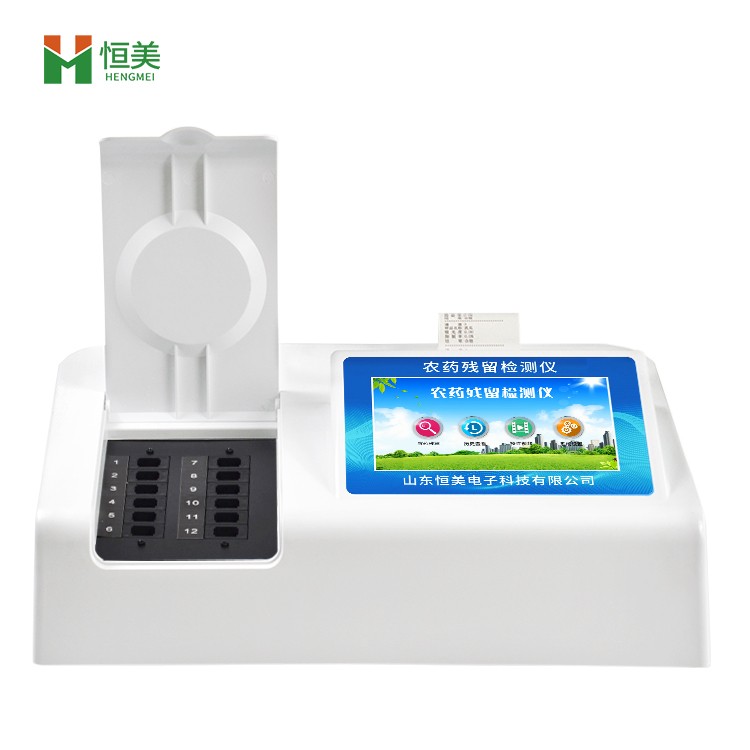
The HM-NC12 bench detector used as the reference in this procedure has 12 channels, a fixed 412 nm measurement wavelength, a transmittance repeatability of ≤0.5% and drift of ≤0.005 Abs per 3 minutes — specifications that suit a daily batch of ten samples with controls. Reagents for 300 tests are supplied as standard, which covers roughly 25 batches at twelve tests each.
Where testing also happens at the point of harvest, the same procedure applies with a portable unit; the field screening workflow covers the power, temperature and reagent logistics that differ. HENG MEI Intelligent Manufacturing supplies both formats plus the 40-position automatic analyser, so a programme can keep one procedure across sites.
To adapt this procedure to your programme, tell our sales contact the matrices you test, the threshold your authority applies and the confirmation laboratory you use. Those three facts determine the dilution steps and the decision band in the written rule.
Contact: Grace, Sales Contact, graceliu@hmdzkj.cn, +86 17853698681 (Tel / WhatsApp / WeChat).
Address of this article:https://www.hmfoodtesting.com/article/pesticide-screening-sop-canteens-produce-bases.html
 Return to List